OnlyFans Taxes in the United States: Complete Guide for Creators
If you’re making money on OnlyFans in the U.S., taxes are not optional, even if it’s “just extra income,” even if you haven’t received a tax form yet, and ev...

If you’re making money on OnlyFans in the U.S., taxes are not optional, even if it’s “just extra income,” even if you haven’t received a tax form yet, and even if you use a stage name online. The good news is that once you understand the basics, OnlyFans taxes become a repeatable system you can run every month.
This guide breaks down what U.S. creators typically need to know: how your income is taxed, what to track, common deductions, how quarterly estimated taxes work, and how to avoid the painful surprise of a big bill in April.
Disclaimer: This is educational, not legal or tax advice. Laws and platform policies can change. Verify details with the IRS, your state, and a qualified tax professional.
How OnlyFans income is taxed in the U.S. (the simple version)
In most cases, OnlyFans creators are treated like self-employed individuals (a business), not employees. That usually means two big things:
- You report income and expenses on Schedule C (Profit or Loss From Business).
- You may owe self-employment tax (Social Security and Medicare) in addition to regular income tax.
Even if you also have a W-2 job, your creator income is generally still separate business income.
To confirm how the IRS views self-employment and business income, start here: the IRS page on self-employed individuals.
The 3 layers of taxes creators commonly face
Most creators deal with some combination of these:
| Tax type | What it is | How it’s usually paid | What triggers it |
|---|---|---|---|
| Federal income tax | Tax on your total taxable income | Withholding (W-2) and/or estimated payments | Profit from your creator business increases taxable income |
| Self-employment tax | Social Security + Medicare for self-employed people | Usually via estimated payments | Net profit from Schedule C |
| State and local taxes | Varies by state/city | Estimated payments or at filing time | Living and doing business in a taxing state/city |
Some states also have additional rules (and some have no state income tax). If you moved mid-year, travel often, or have residency questions, a CPA is worth it.
What counts as “income” on OnlyFans?
Generally, all money you earn from your creator business is taxable income, including:
- Subscriptions
- Tips
- Pay-per-view (PPV)
- Custom content
- Paid messaging and bundles
- Referral income (if applicable)
A common mistake is thinking only payouts are taxable. In practice, you typically report income you actually received (cash basis is common for small businesses), but your bookkeeping should still be consistent and match your bank deposits and platform records.
“Do I need a 1099 to report income?” (No)
You can owe taxes even if you don’t receive a 1099. Tax forms are reporting tools, not permission slips.
Depending on how payouts are processed, you may receive a form such as a 1099-K or another information return. Thresholds and rules have changed in recent years and can change again, so it’s smart to:
- Check what tax form(s) you received (if any)
- Compare forms to your own income tracking
- Report accurate totals even if a form is missing or incorrect
For current rules and updates, use the IRS hub for information returns.
The creator tax workflow: a system you can actually stick to
Here’s a realistic framework you can follow without turning your life into spreadsheets.
Step 1: Separate your money (best habit you can build)
If you do nothing else, do this:
- Open a separate bank account for creator income and business expenses
- Use a separate card for business purchases
- Keep your personal spending separate
This single change makes tax time dramatically easier.
Step 2: Track 4 numbers every month
At the end of each month, record:
- Gross income (what you earned)
- Platform fees and processing fees (if shown)
- Refunds/chargebacks (if any)
- Business expenses (categorized)
If you want to run your OnlyFans like a business (and not guess what’s working), tracking is also a growth tool, not just a tax tool. This pairs well with using tracking links to understand your traffic sources. See: OnlyFans Tracking Links Guide.
Step 3: Set aside money for taxes automatically
Many creators do a simple “set-aside” system from every payout. The exact percentage depends on your income, state, deductions, and whether you have other income.
A safer approach is:
- Start conservatively (higher set-aside if you’re unsure)
- Adjust after you see your real profit and your CPA’s guidance
If you prefer official guidance on estimated taxes, the IRS overview is here: Estimated taxes.
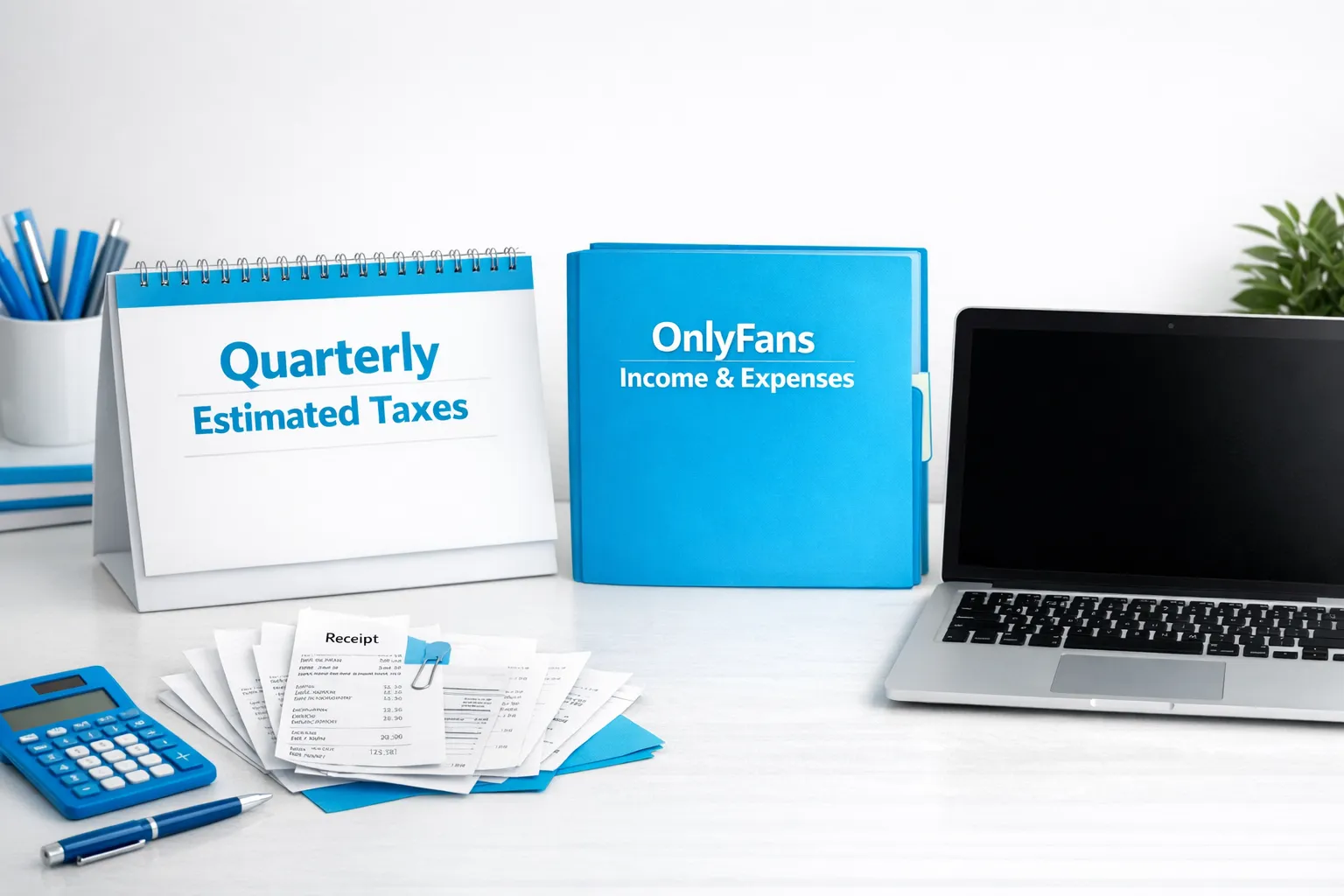
Step 4: Pay quarterly estimated taxes (when needed)
If you expect to owe a meaningful amount at filing time, you may need to pay quarterly estimated taxes. Many creators get hit with penalties and stress simply because they didn’t know this existed.
Quarterly payments are commonly due in April, June, September, and January, but always confirm current due dates on the IRS site because deadlines can shift.
Common OnlyFans tax deductions (what creators usually track)
Deductions reduce your taxable profit. The key idea is that expenses must be ordinary and necessary for your business.
Here’s a practical list of categories many creators track (not all will apply to you):
| Deduction category | Examples (creator-specific) | Notes to be careful about |
|---|---|---|
| Content production | Lighting, tripod, camera, backdrops, props | Keep receipts and document business use |
| Editing and software | Editing apps, scheduling tools, cloud storage | Subscription invoices help a lot |
| Marketing | Promo tools, design assets, paid ads (where allowed), link-in-bio tools | Avoid tactics that violate platform ToS |
| Wardrobe and styling | Lingerie, costumes, makeup, hair | This area can be tricky, ask a tax pro about what qualifies |
| Home office | Portion of rent, utilities, internet (if eligible) | Must meet IRS rules, not just “I work from my bed” |
| Phone and internet | A business-use portion of your plan | Track reasonable business percentage |
| Professional services | CPA, bookkeeping, legal consults | Usually straightforward if clearly business-related |
| Travel (business-related) | Travel specifically for shoots/collabs | Requires strong documentation to be defensible |
For IRS-friendly explanations of business expenses, you can reference IRS Publication 535 (Business Expenses).
A quick “is this deductible?” decision filter
Ask yourself:
- Would I still buy this if I did not run my OnlyFans business?
- Can I explain the business purpose clearly in one sentence?
- Do I have proof (receipt + notes) and a clear connection to income?
If the answer is fuzzy, treat it as a “maybe,” and ask your CPA.
Recordkeeping for creators: what to save (and how)
The IRS cares less about your aesthetic and more about your documentation.
Keep these documents
- Bank statements for your creator account
- Monthly payout records from the platform
- Receipts and invoices for expenses
- Software subscriptions and email confirmations
- A simple log for mixed-use items (phone, internet, home office)
A simple folder system
- 2026 Taxes → Income → January to December
- 2026 Taxes → Expenses → by category
- 2026 Taxes → Forms and filings
Stage name, privacy, and taxes (what’s true, what’s risky)
A stage name is a branding choice. Taxes are a legal identity issue.
- Your tax filings are under your legal name and SSN (or EIN if you have one).
- You can keep your personal details more private publicly, but you still need accurate tax reporting.
If privacy is a major concern for you, also build safety habits into your promo and account setup. This article can help: How to Secretly Promote Your OnlyFans (Without Friends or Family Finding Out).
LLC vs sole proprietor: should creators form a business?
Many creators start as a sole proprietor by default (no formal setup required). An LLC can be helpful for liability and organization, but it is not a magic tax hack.
Whether it makes sense depends on:
- Your income level and risk tolerance
- Whether you work with others (collabs, contractors)
- How cleanly you separate finances
- Your state fees and admin burden
This is one of those “it depends” topics where a short consult with a CPA or attorney can save you money and stress.
Working with a CPA: when it’s worth it
If any of these are true, getting professional help is usually a good decision:
- You are making consistent money monthly
- You are unsure about quarterly estimated taxes
- You have lots of write-offs and mixed-use expenses
- You moved states, travel for shoots, or have complex life changes
- You want to set up an LLC or hire help
Questions to ask a CPA (copy/paste)
Use this as a quick screening script:
- “Do you work with self-employed creators or online businesses?”
- “How do you recommend I track income and expenses month to month?”
- “Should I be paying quarterly estimated taxes based on my numbers?”
- “What deductions are commonly missed in my type of business?”
- “If I form an LLC, what changes for taxes in my state?”
Tax mistakes that hit OnlyFans creators the hardest
These are the patterns that create panic:
- Not setting aside money for taxes
- Waiting until April to look at profit
- Mixing personal and business spending
- Over-aggressive deductions without documentation
- Forgetting state taxes (or moving and not planning)
If you’re also scaling fast, your taxes can get messy quickly because expenses and payouts ramp up at the same time. That’s why a simple monthly “closeout” routine matters.
A monthly and quarterly checklist (keep it boring, keep it consistent)
Monthly closeout (30 minutes)
- Export or screenshot payout summaries
- Update your income total and expense totals
- Upload receipts to your folder
- Note unusual items (new phone, travel, major equipment)
Quarterly check-in (60 minutes)
- Estimate your profit year-to-date
- Sanity-check your tax set-aside amount
- If needed, make an estimated tax payment
If you’re actively optimizing monetization, it also helps to compare revenue streams (subs vs PPV vs customs). For tactical monetization strategy, see: How to Sell Content on OnlyFans: A Step-by-Step Guide.
Frequently Asked Questions
Do I pay taxes on tips and gifts on OnlyFans? Yes, tips are generally taxable income. In most cases, money you receive through your creator business is taxable.
What if I didn’t get a 1099 from OnlyFans (or the payout provider)? You still need to report your income. Tax forms help reporting, but they don’t determine whether you owe taxes.
Can I deduct lingerie, makeup, and hair? Sometimes, but it can be a gray area depending on facts and documentation. If it can be argued as personal use, it’s worth asking a CPA how to handle it properly.
Do I need to pay quarterly estimated taxes? Many self-employed people do. It depends on how much you expect to owe beyond any withholding from other income. Check the IRS estimated tax guidance and confirm with a professional.
Should I form an LLC for my OnlyFans? It depends. An LLC can help with liability and organization, but it does not automatically reduce taxes. Your state fees, income level, and work setup matter.
Will using a stage name protect me from taxes or reporting? No. Your taxes are filed under your legal identity. A stage name can protect your brand and privacy publicly, but it doesn’t change your tax obligations.
Want to scale your income without drowning in admin?
Taxes are one part of treating OnlyFans like a real business. The other part is building systems that keep your income consistent: marketing, fan growth, content planning, and DM sales.
Lookstars is an OnlyFans management agency that helps creators handle the time-consuming parts of growth, including multi-platform marketing, strategic posting, 24/7 fan chatting, and privacy-focused support like leak monitoring and takedowns. You stay focused on content and boundaries, while the business side runs like a machine.
If you’re ready to scale with a team (without upfront costs or long-term contracts), apply here: Lookstars Agency.



Ready to transform your career?
Join hundreds of creators already earning six figures with Lookstars Agency.
Share this article
Best OnlyFans Agency
Europe's Leading OnlyFans Management Agency.

100% Free Ebook
Get our guide and unlock the secrets to OnlyFans success.
100% Free Ebook
Get our guide and unlock the secrets to OnlyFans success.
Free Revenue Calculator & Profile Analyzer
Try them for freeContinue reading...

Am I Attractive Enough for an OnlyFans Agency? The Answer

Can You Ever Fully Delete Your OnlyFans Content? The Reality