OnlyFans Taxes for High-Earning Creators (EU & US Guide)
If you’re earning “real money” on OnlyFans, taxes stop being an annoying admin task and start becoming a risk management problem. The good news is you don’t ...

If you’re earning “real money” on OnlyFans, taxes stop being an annoying admin task and start becoming a risk management problem. The good news is you don’t need to be a finance girlie to stay compliant and keep more of what you earn. You just need a clean system, a realistic set-aside plan, and the right pro support at the right time.
This guide is educational, not legal or tax advice. Tax rules and platform reporting can change. Always verify with official guidance or a qualified tax professional in your country/state.

The high-earner tax mindset (what changes after you scale)
When you’re doing a few hundred bucks a month, you can often “fix it later.” When you’re doing $5k, $10k, or $20k+ per month, waiting is how creators get trapped.
Here’s what usually breaks at higher income:
- Cash flow gets messy because OnlyFans payouts rarely match the month you earned the money.
- Your tax bill becomes large enough to hurt, even if you have deductions.
- Your privacy and documentation matter more (banks, landlords, government mail, potential audits).
- International fans and multi-platform income can create cross-border complexity.
So the goal is not “find a loophole.” The goal is predictability.
Step 1: Know your real numbers (gross, fees, chargebacks, net)
A common mistake is treating your payout as your income. For taxes and bookkeeping, you want clarity on three separate numbers:
- Gross revenue earned (subscriptions, tips, PPV, paid messages, customs, bundles).
- Platform fees and refunds (OnlyFans takes a cut, plus chargebacks/refunds can happen).
- Net payout received (what hits your bank).
Why it matters: in many tax systems, you report income based on accounting method (cash vs accrual rules vary by country and situation), and your platform forms may report gross amounts. If your records only show payouts, you can end up under-reporting (or scrambling to reconcile).
If you want a simple tracking blueprint, start with this (and keep it consistent):
| What to track | What it answers | Where you usually find it |
|---|---|---|
| Gross earnings by day/week | “How much did I actually earn?” | OnlyFans statements/dashboard exports |
| Fees withheld | “How much did the platform keep?” | Platform statements |
| Refunds/chargebacks | “Why did revenue drop after a good week?” | Statements, dispute notes |
| Payouts received | “How much cash landed in my bank?” | Bank feed + payout history |
| Business expenses | “What can I legitimately deduct?” | Receipts + card/bank transactions |
Related deep dives you might want next:
Step 2: Build a “tax set-aside” that matches your reality (not vibes)
High earners usually get in trouble for one reason: they spend from the tax money.
A set-aside system is just a routine that makes that harder.
A simple set-aside method (works in the US and most EU countries)
- Open a separate savings account (or sub-account) just for taxes.
- Every payout day, transfer a fixed percentage into that account.
- Don’t touch it except for tax payments.
How much should you set aside? It depends on your country, state, deductions, filing status, and social contributions. If you don’t know yet, start conservatively and adjust with a tax pro.
If you’re already earning $10k+/month and you’ve never made estimated payments or prepayments, don’t guess forever. Get a professional calculation.
Step 3: US guide for high-earning OnlyFans creators
How OnlyFans income is typically taxed in the US
Most US creators are treated as self-employed (sole proprietor by default unless you’ve set up a different structure). That usually means:
- Federal income tax
- Self-employment tax (Social Security and Medicare)
- Potential state and local income tax
Official starting point for self-employed taxes:
Estimated quarterly taxes (the part that surprises creators)
Many creators need to pay taxes throughout the year, not just in April. The IRS calls these estimated tax payments.
The due dates are usually in April, June, September, and January, but can shift for weekends/holidays. Verify each year here: Estimated taxes (IRS).
If you’re a high earner, estimated taxes matter because penalties can apply if you underpay.
A common safe approach is using the IRS “safe harbor” concept (rules depend on your prior-year tax and income level). This is exactly the kind of thing a CPA can set up quickly once your bookkeeping is clean.
The 1099 form problem (and how to avoid panic)
You might receive a 1099 form related to your OnlyFans income (type and thresholds can vary by year and reporting rules). Two important truths:
- You generally must report taxable income even if you don’t get a 1099.
- Your 1099 may not match your payouts (because it can reflect gross amounts).
So your plan should be: reconcile your own tracking to platform statements monthly, then you’re never held hostage by a form.
When an LLC or S-corp conversation becomes worth it
In the US, an LLC can help with separation and professionalism, but it does not automatically lower taxes. Some higher-earning creators explore S-corp taxation (if eligible) to potentially optimize self-employment tax, but it adds payroll, compliance, and accounting costs.
This is a “run the numbers with a CPA” decision, not a TikTok decision.
If you want the non-hype framework first: LLC for OnlyFans: when it makes sense
Step 4: EU guide for high-earning OnlyFans creators
The EU is not one tax system. You’re dealing with your country’s rules, and sometimes regional rules too.
That said, most high-earning EU creators run into the same buckets:
1) Income tax and social contributions
In many EU countries, once you’re consistently earning, you may need to register as self-employed (or your local equivalent), file annual returns, and pay social security style contributions.
The “high earner” difference is timing: some countries require prepayments, periodic filings, or advance contributions once your income reaches a certain point.
2) VAT: what creators should understand (without spiraling)
VAT is where creators get overwhelmed, especially with international fans.
Two key points:
- On many platforms, VAT on digital consumer sales is handled by the platform as the seller of record (this can vary by platform structure and local interpretation).
- You still might have VAT obligations related to how your country treats the service you provide (for example, a B2B service to a platform, reverse charge rules, registration thresholds, invoicing requirements).
Because this is country-specific, don’t rely on Reddit answers. Take your country and ask a VAT-aware accountant.
Helpful official reference for EU VAT basics: Your Europe, VAT rules
3) Multi-country income (moving, traveling, or relocating)
If you live in one EU country and spend significant time in another, or you relocate mid-year, you can create split-year tax residency issues. That’s not scary, but it is paperwork.
High earners should document:
- Where you were resident and when
- Where your bank is
- Where your business is registered (if applicable)
- Contracts and platform payout statements
This is one of the strongest reasons to hire a pro early.
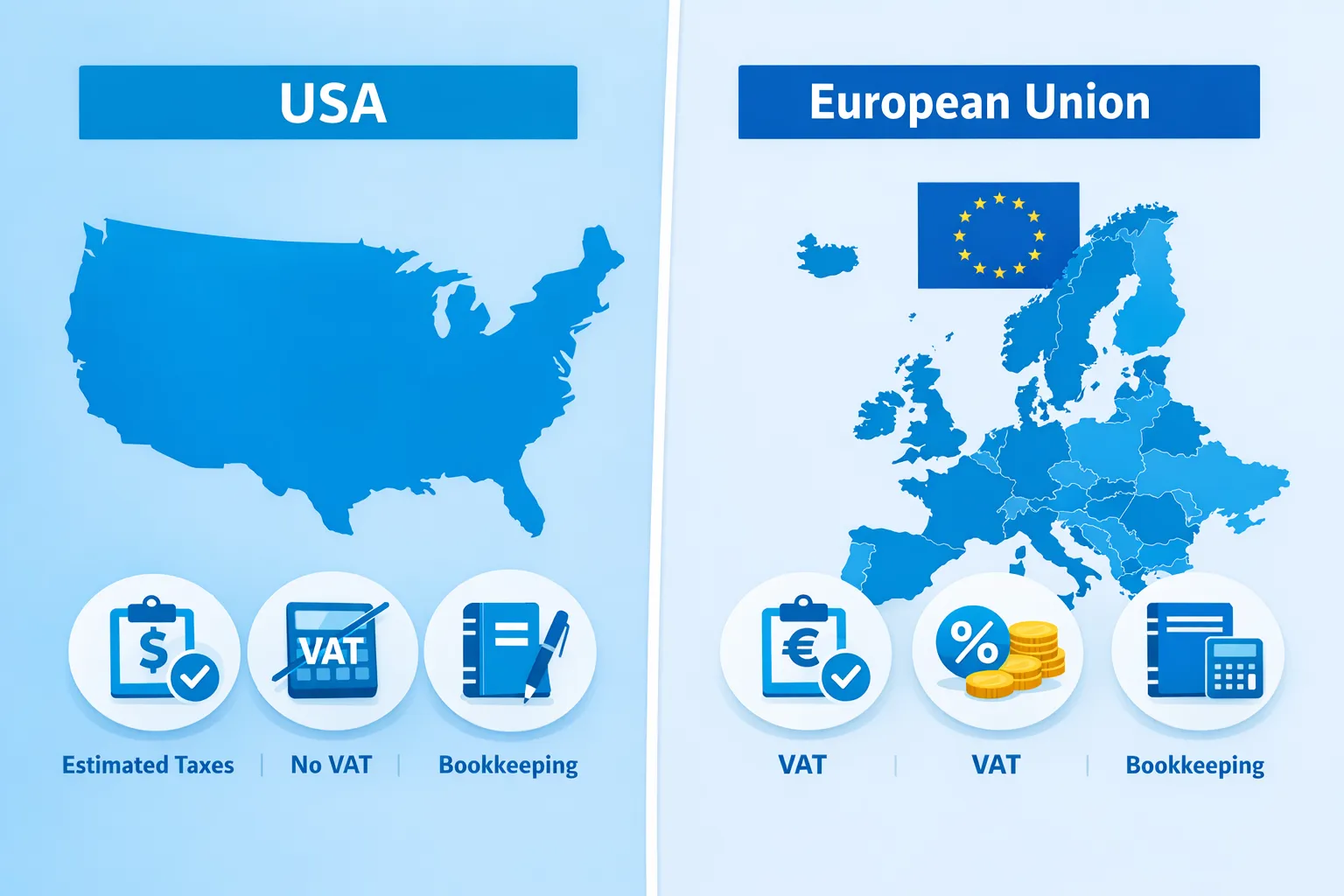
Step 5: The “High-Earner OnlyFans Tax Stack” (a practical framework)
Use this framework to stop reacting and start controlling your taxes.
Layer A: Clean bookkeeping (weekly)
If you do nothing else, do this.
- Download/export platform statements (or at least screenshot totals).
- Log income and expenses.
- Save receipts in a folder that matches your spreadsheet categories.
If you need a routine that’s not exhausting, use the weekly system here: OnlyFans taxes: weekly habit to stay organized
Layer B: Tax set-aside + payments (monthly/quarterly)
- Transfer tax set-aside on payout days.
- If you’re in the US, plan estimated payments.
- In the EU, ask your accountant if prepayments are expected after a strong year.
Layer C: Deductions with proof (always)
Deductions are real, but only when they’re documented and legitimate.
If you want the most commonly missed categories plus what documentation to keep: Top tax deductions OnlyFans creators often miss
Layer D: Entity, banking, and privacy (when income is consistent)
High-earning creators benefit from separation:
- A dedicated business bank account/card
- A clear legal name vs stage name workflow (for invoices, banking, taxes)
- A professional you trust with privacy
If you’re also dealing with international payout friction, read: International payouts: how to avoid common delays
A decision table: DIY vs bookkeeper vs tax pro (for high earners)
Use this to decide what support you need right now.
| Your situation | DIY is fine if… | Consider a bookkeeper if… | Consider a tax pro/CPA if… |
|---|---|---|---|
| $2k to $5k/month, single platform | You track weekly and stay consistent | You hate admin and fall behind monthly | You’re unsure about deductions and payments |
| $5k to $15k/month, steady | You already have clean categories and reconciliations | You have lots of expenses, contractors, or content tools | You need estimated payments, planning, or entity advice |
| $15k+/month, multi-platform or cross-border | Rarely recommended | Helps keep everything clean | Strongly recommended for planning and risk control |
Copy/paste template: message to hire a tax professional (US or EU)
If you’re nervous about judgment, keep it simple and businesslike. You’re not asking permission, you’re hiring help.
Template:
Hi! I’m a digital content creator and I earn income through subscription platforms. I want to get fully compliant and set up a clean system for (1) income tracking, (2) deductible expenses, and (3) estimated payments or prepayments. I can share monthly statements, payout reports, and an expense tracker.
Can you confirm:
- Whether you work with online creators (subscription and paid-message income)
- What you need from me to estimate my tax payments going forward
- How you recommend handling platform statements vs bank payouts in bookkeeping
- Your pricing and timeline for onboarding
Thank you.
Common mistakes high-earning creators should avoid
These show up again and again:
- Waiting until March or April to look at last year’s numbers.
- Mixing personal and business spending so deductions become hard to defend.
- Tracking payouts only and ignoring gross revenue and refunds.
- Buying “tax hacks” online without verifying local rules.
- Underestimating privacy needs (government mail, addresses, who has access to documents).
Frequently Asked Questions
Do I pay taxes on OnlyFans payouts or total earnings? You generally want to track gross earnings, fees, refunds, and payouts, then file according to your country’s rules and your accounting method. A tax pro can confirm the correct approach for you.
I’m in the EU. Do I need to charge VAT to my subscribers? Often the platform handles VAT on consumer sales, but VAT obligations can still exist depending on how your country treats your activity and your relationship to the platform. This is country-specific, so verify with a local VAT-aware accountant.
If I didn’t receive a 1099, can I ignore the income? In the US, you generally report taxable income regardless of whether you receive a 1099. If you’re unsure what was reported, reconcile your own records to platform statements.
What’s the biggest tax “level up” for high earners? Consistent bookkeeping plus a set-aside system. Once that’s in place, a CPA can optimize your payment plan and entity decisions much faster.
Can forming an LLC reduce my taxes automatically? Not automatically. An LLC can help with separation and professionalism, but tax outcomes depend on elections, profit, payroll (in some structures), and compliance costs. Get a real calculation before changing anything.
Want more time to create, and less time stuck in admin?
Taxes get easier when your business runs cleanly, but high-earning creators also hit another problem: you’re doing too many jobs at once (content, posting, promo, DMs, upsells, leak monitoring, admin).
Lookstars is an OnlyFans management agency that helps creators scale with marketing, 24/7 fan chatting, posting strategy, and privacy protection, with no upfront costs and flexible, cancel-anytime contracts. If you want support so you can stay focused on content and keep your business organized, you can apply here: Lookstars Agency.



Ready to transform your career?
Join hundreds of creators already earning six figures with Lookstars Agency.
Share this article
Best OnlyFans Agency
Europe's Leading OnlyFans Management Agency.

100% Free Ebook
Get our guide and unlock the secrets to OnlyFans success.
100% Free Ebook
Get our guide and unlock the secrets to OnlyFans success.
Free Revenue Calculator & Profile Analyzer
Try them for freeContinue reading...

Am I Attractive Enough for an OnlyFans Agency? The Answer

Can You Ever Fully Delete Your OnlyFans Content? The Reality